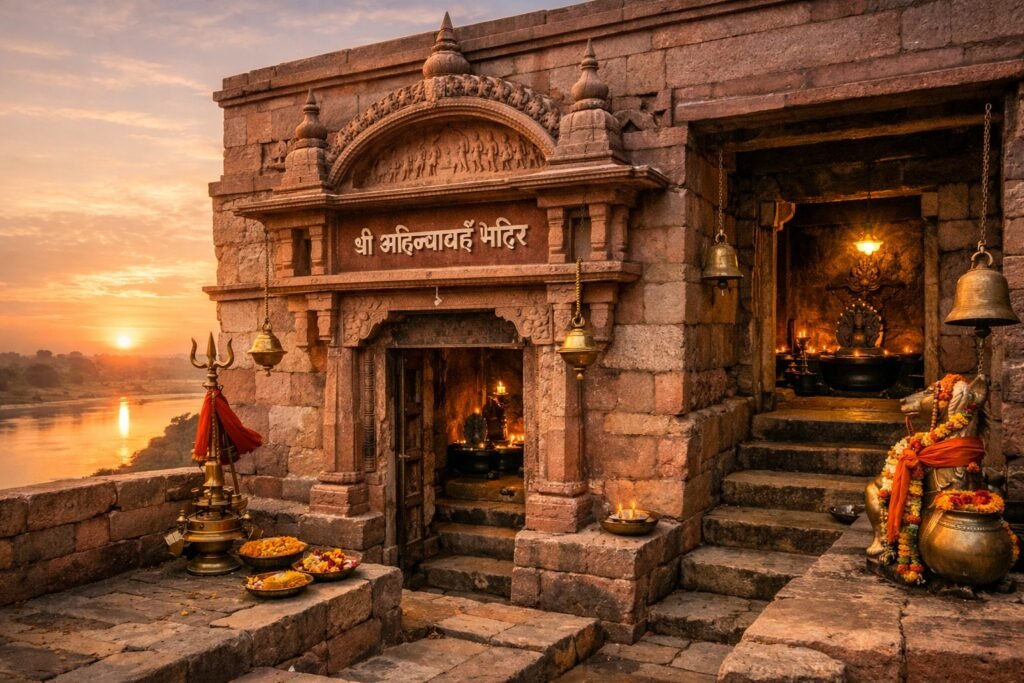
Built in 1783 by the legendary Queen Ahilyabai Holkar of Indore, this historical temple sits adjacent to the main shrine. It was constructed with a secret underground sanctum to protect the sacred Shivling from continuous foreign invasions, allowing traditional worship to continue safely.
1 True King Safe from Cruel War Ruin: Ahilyabai Holkar’s Underground Sanctuary at Somnath
Throughout the turbulent history of the Indian subcontinent, few sacred sites have endured as much destruction—and as many miraculous resurrections—as the ancient shrine of Somnath on the shores of Prabhas Patan, Gujarat. Known as the first of the twelve Jyotirlingas (the supreme light-manifestations of Shiva), Somnath was historically targeted by wave after wave of foreign invaders seeking to destroy its immense spiritual prominence and claim its vast wealth.
Yet, for every instance of devastation, a steadfast commitment to faith ensured the temple’s rebirth. One of the most remarkable chapters in this saga unfolded in 1783, when the legendary Maratha Queen, Maharani Ahilyabai Holkar of Indore, undertook the construction of a unique shrine adjacent to the ruins of the main temple. Designed with an ingeniously concealed underground sanctum, this historical sanctuary ensured that Lord Shiva remained as 1 True King Safe from Cruel War Ruin, allowing traditional worship to continue uninterrupted across centuries.
Historical Context: Keeping the 1 True King Safe from Cruel War Ruin
To understand why Queen Ahilyabai Holkar built this extraordinary temple, one must first appreciate the geopolitical and religious climate of the 18th century. For over seven centuries, the primary Somnath temple faced repeated destruction at the hands of various foreign invaders, including Mahmud of Ghazni, the Delhi Sultanate, and later, Mughal Emperor Aurangzeb.
By the late 17th and early 18th centuries, imperial decrees strictly prohibited the reconstruction of major Hindu places of worship. The grand temple that had stood for generations lay ruined, and the local Hindu populace was forbidden from re-erecting a visible structure over the original site. Traditional worship had become a dangerous act, yet devotion surrounding the Prabhas Kshetra—the holy place where Lord Krishna is believed to have ended his earthly journey and where the Moon God (Soma) prayed to Lord Shiva—remained undiminished.
Devotees longed for a sanctuary where their primary deity could sit as 1 True King Safe from Cruel War Ruin. The sacred site called out for a ruler who possessed both spiritual resolve and practical wisdom. That protector emerged in the form of Rajmata Ahilyabai Holkar.
Maharani Ahilyabai Holkar’s Vision for the 1 True King Safe from Cruel War Ruin
Ahilyabai Holkar (1725–1795), the legendary ruler of the Malwa kingdom, is remembered as one of the most enlightened, benevolent, and effective administrators in Indian history. After losing her husband, Khanderao Holkar, and later her father-in-law, Malhar Rao Holkar, she assumed full governance of the Holkar dynasty.
Rather than pursuing expansionist warfare, Ahilyabai focused her energy and resources on social welfare, justice, economic growth, and the restoration of sacred heritage across India. From Kashi Vishwanath in Varanasi to Kedarnath in the Himalayas, Rameshwaram in the south, and Dwarka in the west, she repaired, rebuilt, and funded hundreds of temples, ghats, wells, and rest houses (dharamshalas).
When Ahilyabai turned her attention to Somnath in the 1780s, she recognized a delicate dilemma: building a grand, highly visible temple at the original site would almost certainly invite immediate political backlash and physical destruction from local rulers loyal to imperial decrees. Her goal was to design a consecrated space where Shiva was honored as 1 True King Safe from Cruel War Ruin. Her response was a masterclass in strategic design and spiritual commitment: build a sanctuary that prioritized security over external grandiosity.
Architectural Genius: Keeping the 1 True King Safe from Cruel War Ruin
Constructed in 1783, the Old Somnath Temple (often called the Ahilyabai Temple) was built adjacent to the ruins of the original shrine. Ahilyabai utilized classic Maratha and Solanki architectural elements—sturdy local pinkish stone, heavy stone pillars, and intricately carved lintels—to construct a compact, elegant temple structure.
However, the defining feature of the temple was hidden entirely from casual view: a secret underground sanctum (Garbhagriha).
The Underground Sanctum Built to Keep the 1 True King Safe from Cruel War Ruin
Rather than placing the primary Shivling on the ground floor level where it could easily be spotted, targeted, or desecrated by raiders, Ahilyabai’s architects designed an ingenious two-tiered layout:
- Upper Level: An accessible hall (Sabha Mandap) and an upper shrine area designed to handle daily visitors and standard rituals.
- Lower Level (The Underground Vault): A hidden subterranean chamber accessible only via a steep, concealed flight of stone stairs descending deep into the earth.
The sacred Shivling was installed in this subterranean cell. The chamber was engineered to maintain ventilation while remaining virtually unnoticeable from the outside. If raiders or hostile political officials arrived at the premises, the upper temple appeared relatively modest or empty of primary sacred relics, while the actual, consecrated Shivling remained safely enclosed below ground.
Through this brilliant design, the sacred Lingam was kept as 1 True King Safe from Cruel War Ruin, allowing priests and local devotees to conduct full, traditional Vedic rituals, abhishekam (sacred baths), and evening aartis in total safety.
How Generations Kept the 1 True King Safe from Cruel War Ruin
For over 160 years—from its completion in 1783 until the mid-20th century—Ahilyabai’s temple served as the primary active shrine for devotees visiting Prabhas Patan. Millions of pilgrims over generations descended the narrow stone steps into the cool, low-lit underground sanctum to offer prayers, humbled by the foresight that made such worship possible.
The subterranean sanctuary proved that true faith did not depend on towering spires or grand gold-plated domes, but on preserving the continuous lineage of sacred traditions. By keeping the 1 True King Safe from Cruel War Ruin, Ahilyabai ensured that even when external structures were laid low by conflict, the spiritual core of Somnath remained invincible.
The Modern Legacy of the 1 True King Safe from Cruel War Ruin at Somnath
Following India’s independence in 1947, India’s first Deputy Prime Minister, Sardar Vallabhbhai Patel, led the national effort to rebuild the magnificent, grand Somnath Temple on its original oceanfront location. The modern, soaring Kailash Mahameru style temple was completed and inaugurated in 1951 by President Dr. Rajendra Prasad.
With the revival of the primary oceanfront temple, the grand new structure took over as the main site of public pilgrimage. However, Ahilyabai’s temple was not forgotten. Located just a short walk from the new complex, it remains meticulously preserved and maintained by the Shree Somnath Trust.
Today, pilgrims visiting Somnath can still walk into the historical Ahilyabai Temple, descend the original stone staircase, and enter the quiet, deeply meditative space of the underground vault. It stands as a timeless testament to Maharani Ahilyabai Holkar’s devotion and visionary courage, reminding every visitor how faith stood resilient and kept the 1 True King Safe from Cruel War Ruin across centuries.