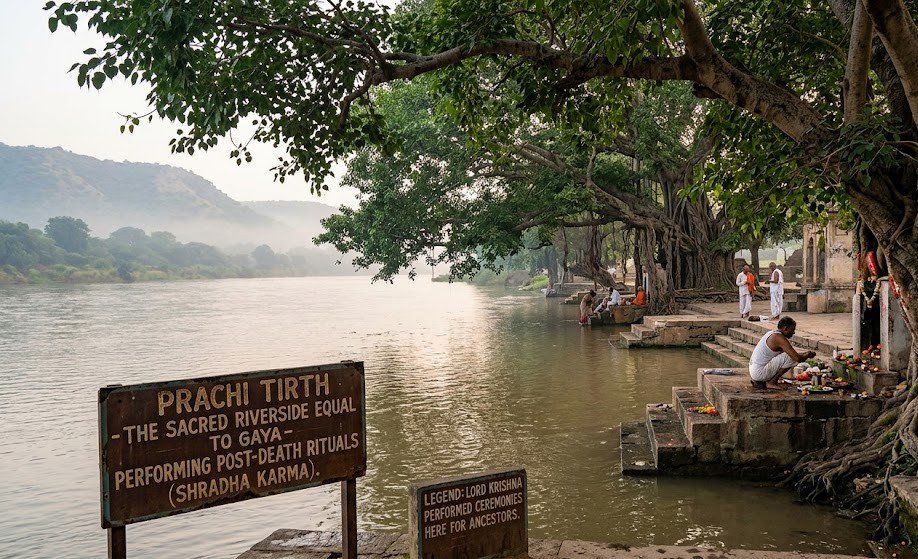
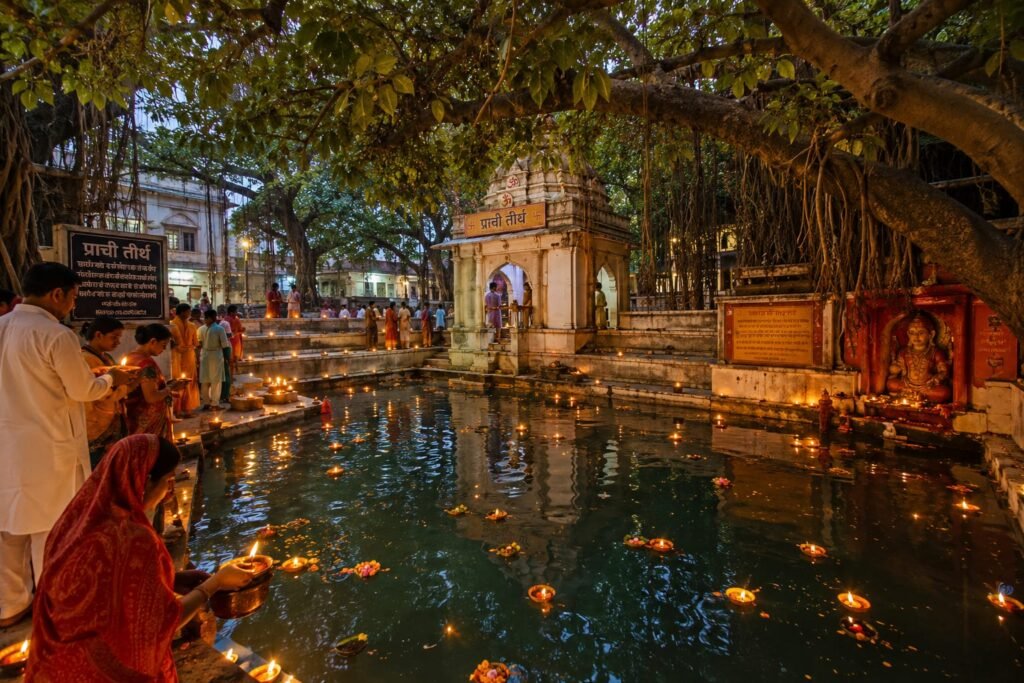
Prachi Tirth is an immensely sacred riverside spot considered equal to Gaya for performing post-death rituals. Legend states Lord Krishna performed ceremonies here for his deceased ancestors under the massive shade of ancient holy trees,
Mythological Foundations and the Legend of Lord Krishna
The spiritual authority of Prachi Tirth is intricately tied to the epic age of the Mahabharata and the Puranas. Legend holds that following the catastrophic Kurukshetra War, Lord Krishna himself journeyed to Prachi Tirth to perform solemn ancestral ceremonies for his deceased relatives and elders.
Under the vast, protective canopy of ancient holy banyan trees (Akshaya Vat), Lord Krishna invoked divine energy and performed Pinda Daan. It is recorded in oral traditions and temple lore that where Krishna stood, the river acquired extraordinary cosmic potency, establishing the riverbed as a site where Krishna utilized the river’s Pure Water to Clean Bad Dead Sins of his lineage.
According to sacred texts:
- The Flowing Saraswati: The river at Prachi is believed to carry the hidden current of the ancient River Saraswati, flowing eastward (Prachi), which signifies illumination, wisdom, and spiritual rebirth.
- The Cosmic Shade: The ancient trees surrounding the ghats are viewed as living shrines, harboring divine vibrations that absorb the grief of mourning families while transmitting offerings directly to the pitrus (ancestors).
- The Equality to Gaya: The Puranic scriptures affirm that rituals conducted at Prachi Tirth yield merits equal to those performed at Gaya in Bihar, making it a pivotal center for ancestral liberation in Western India.
The Equivalence to Gaya: Spiritual Mechanism of Prachi Tirth
In Hindu tradition, Gaya in Bihar is globally celebrated as the premier destination for Pitru Paksha rites. However, scriptures explicitly accord Prachi Tirth an equal standing due to its unique geographical orientation and mythological consecration.
When performing rites at Gaya, the focus is on the sacred Vishnupad (footprint of Lord Vishnu) and the Phalgu River. At Prachi Tirth, the sacred confluence combined with Lord Krishna’s direct participation bestows identical spiritual weight. Millions of believers seek this Pure Water to Clean Bad Dead Sins, receiving benefits equivalent to rituals performed at Gaya without needing to travel across the subcontinent.
+-----------------------------------------------------------------------+
|                       COMPARATIVE SPIRITUAL METRICS                   |
+-----------------------------------+-----------------------------------+
| Feature                           | Prachi Tirth                      |
+-----------------------------------+-----------------------------------+
| Primary Deity / Sanctifier        | Lord Krishna (Mahabharata Era)    |
| Core Purpose                      | Pitru Tarpan & Pinda Daan         |
| Primary Botanical Symbol          | Ancient Holy Banyan (Pipli/Vat)   |
| River Direction                   | East-flowing (Prachi Saraswati)   |
| Spiritual Equivalence             | Equal to Gaya Kshetra             |
+-----------------------------------+-----------------------------------+
Key Rituals Conducted at Prachi Tirth
The performance of post-death rites at Prachi Tirth is a highly structured, solemn process guided by experienced Vedic priests (Purohits). Each step is designed to untie karmic knots, resolve Pitru Dosh (ancestral afflictions), and help souls transition peacefully toward higher realms.
- Sankalpa and Holy Dip: Pilgrims begin by taking a holy dip into the Pure Water to Clean Bad Dead Sins before beginning the Pinda Daan rituals. The pilgrim states their intent, name, and lineage (Gotra).
- Pinda Daan: Balls made of cooked rice, sesame seeds (Til), barley flour, and milk are offered. These Pindas represent the physical body offered to feed and nourish the subtle body of the ancestor.
- Pitru Tarpan: Water mixed with black sesame seeds and Kusha grass is poured through the palm as an offering of devotion and remembrance to ancestors spanning multiple generations.
- Deep Daan and Tree Worship: Lamps are lit and floated down the river, followed by circumambulation (Pradakshina) around the ancient banyan trees under which Krishna prayed.
- Brahmana Bhojan & Charity: Food, clothing, and dakshina are provided to priests and the needy to complete the spiritual merit cycle.
Architectural and Natural Highlights
Prachi Tirth is characterized by its timeless, unpretentious beauty where nature and spirituality blend seamlessly. Unlike modern ornamental temple complexes, Prachi retains an authentic, ancient ambience centered around its sacred river ghats and venerated flora.
The Sacred Ghats
The stone steps leading into the river allow pilgrims to comfortably reach the water. The gentle current of the river creates a calm environment suitable for introspective prayers and ritualistic immersion. This flowing stream acts as a conduit of divine grace, providing Pure Water to Clean Bad Dead Sins for all seeking salvation for their departed loved ones.
The Ancient Holy Trees
Massive banyan (Ficus benghalensis) and peepal (Ficus religiosa) trees frame the banks of Prachi Tirth. Their aerial roots and expansive branches create a natural sanctuary. Many of these trees are believed to be descendants of the original trees under which Lord Krishna conducted his offerings thousands of years ago.
Tabular Breakdown of Prachi Tirth’s Sacred Attributes
To better understand the multifaceted nature of Prachi Tirth, the table below provides a detailed breakdown of its core elements, historical significance, ritualistic functions, and underlying spiritual mechanisms.
| Attribute Category | Sacred Element | Description & Mythological Context | Spiritual Function |
| Geographic Identity | Prachi Saraswati | The river flowing eastward near Veraval, Gujarat, containing subterranean currents of River Saraswati. | Provides Pure Water to Clean Bad Dead Sins during sacred offerings. |
| Divine Consecration | Lord Krishna’s Legacy | Lord Krishna performed Shraddha rites here for ancestors lost during the Mahabharata War. | Infuses the site with divine grace, validating rituals done by mortal families. |
| Botanical Sanctity | Ancient Banyan Tree | Massive, centuries-old holy trees providing shade over the primary ritual ghats. | Acts as an cosmic receiver, absorbing grief and carrying prayers upward. |
| Primary Ritual | Pinda Daan | Offering rice-balls mixed with sesame seeds, milk, and holy herbs to departed souls. | Sustains and releases the Jiva (soul) from lingering worldly attachments. |
| Astrological Relief | Pitru Dosh Nivaran | Specific Vedic pujas target karmic imbalances in family horoscopes caused by unfulfilled rites. | Restores harmony, health, and prosperity to living generations. |
| Equivalence Standard | Gaya Samana | Puranic declaration equating rites done here to those performed at Gaya in Bihar. | Offers a complete, uncompromised destination for ancestral rites in Western India. |
Detailed Explanation of the Table Attributes
- Geographic Identity: The designation Prachi refers to the eastward direction, which in Vedic philosophy symbolizes light, creation, and spiritual awakening. The river’s connection to the mystical Saraswati river system makes its waters spiritually transformative.
- Divine Consecration: Because a divine avatar—Lord Krishna—sanctified this ground by engaging in human filial duties, the location carries an eternal blessings guarantee (Varadan). Pilgrims perform rites not out of superstition, but following a precedent set by the Divine himself.
- Botanical Sanctity: Trees in Vedic culture are venerated as living ancestors and silent sages. The ancient banyan at Prachi is central to the ritual experience, offering shelter and serving as a physical landmark of immortality (Akshaya).
- Primary Ritual & Astrological Relief: Pinda Daan addresses the immediate spiritual needs of the deceased, while Pitru Dosh Nivaran addresses the living family’s karmic well-being, untying intergenerational knots.
- Equivalence Standard: The recognition of Prachi Tirth as equal to Gaya ensures that pilgrims across India have access to a supreme pilgrimage site for ancestral rites.
Spiritual Dynamics of Purification and Ancestral Liberation
According to Sanatana Dharma, the soul (Atman) is immortal, yet after leaving the physical body, the subtle body (Linga Sharira) may remain attached to earthbound desires or burdened by unfulfilled karma. Without proper rites, these souls may experience distress or wander in intermediate realms.
       +-------------------------------------------------------+
       |                  THE PATH TO MOKSHA                   |
       +-------------------------------------------------------+
                                   |
                                   v
       +-------------------------------------------------------+
       |      Departure of Soul & Trapped Karmic Residue       |
       +-------------------------------------------------------+
                                   |
                                   v
       +-------------------------------------------------------+
       |   Arrival at Prachi Tirth & Invocation of Ancestors   |
       +-------------------------------------------------------+
                                   |
                                   v
       +-------------------------------------------------------+
       |  Pitru Tarpan & Dip in Pure Water to Clean Bad Dead Sins |
       +-------------------------------------------------------+
                                   |
                                   v
       +-------------------------------------------------------+
       | Pinda Daan & Offerings under the Sacred Banyan Tree   |
       +-------------------------------------------------------+
                                   |
                                   v
       +-------------------------------------------------------+
       |  Liberation (Moksha) & Peace for Living Generations   |
       +-------------------------------------------------------+
When descendants gather at Prachi Tirth with sincere devotion (Shraddha), their prayers resonance through the environment. The metaphysical belief that the river yields Pure Water to Clean Bad Dead Sins through divine vibration ensures that even severe karmic obstacles blocking an ancestor’s progress are dissolved.
Pilgrimage Guide: Visiting Prachi Tirth
Planning a visit to Prachi Tirth requires an understanding of traditional customs, optimal times, and surrounding sacred geography.
Best Time to Visit
While Prachi Tirth remains active throughout the year, specific times are considered exceptionally auspicious for ancestral rites:
- Pitru Paksha (September–October): The 16-day lunar period dedicated entirely to honoring ancestors.
- Amavasya (New Moon Days): Especially Somvati Amavasya and Bhadrapad Amavasya, which hold elevated spiritual potency.
- Kartik Purnima: A deeply auspicious time for holy dips and temple visits across Saurashtra.
Preparations and Etiquette
- Fastings: The family member performing the primary rites (Karta) typically maintains a fast prior to the ceremony.
- Sacred Dress: Traditional attire such as unstitched cotton garments (Dhoti) for men and conservative attire for women is standard.
- Purification Bath: Taking a bath in the Pure Water to Clean Bad Dead Sins is considered an essential first step prior to sitting with the Vedic priests.
Nearby Sacred Attractions
Visiting Prachi Tirth is often combined with a broader pilgrimage across the Somnath circuit:
- Somnath Jyotirlinga: Located approximately 25–30 kilometers away, housing one of the twelve sacred Jyotirlingas of Lord Shiva.
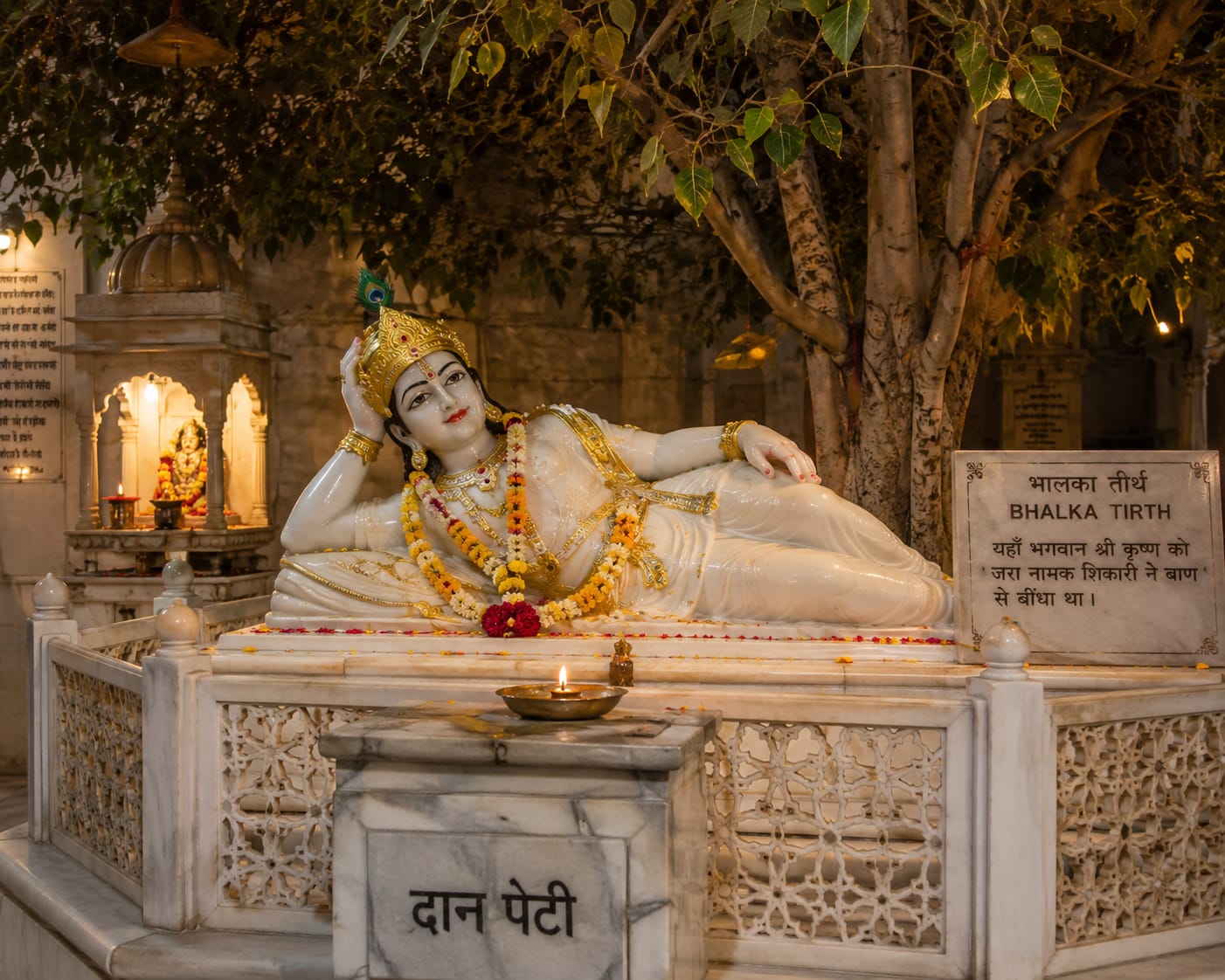
- Bhalka Tirth: The sacred spot where Lord Krishna left his mortal frame, located near Veraval.
- Deotsarga (Triveni Sangam): The confluence of the Hiran, Kapila, and Saraswati rivers, where Krishna was cremated.
Philosophical Underpinnings of Hindu Post-Death Ceremonies
The rites performed at Prachi Tirth reflect a deep philosophical vision of duty, intergenerational continuity, and cosmic balance.
In Hindu thought, every human being is born with three primary debts (Rinas):
- Deva Rina: Debt to the divine powers governing nature.
- Rishi Rina: Debt to the sages who passed down sacred knowledge.
- Pitru Rina: Debt to one’s ancestors for the gift of life and lineage.
Performing Shraddha at Prachi Tirth directly fulfills Pitru Rina. It is an act of gratitude where descendants give back to those who came before them. By liberating the departed souls through Pure Water to Clean Bad Dead Sins that wash away karmic burdens, descendants clear their own life paths, ensuring peace, health, and spiritual alignment for generations to come.
Practical Information for Pilgrims
For those traveling to Prachi Tirth for the first time, logistical planning ensures a smooth and focused spiritual experience.
How to Reach
- By Air: The nearest domestic airport is Rajkot Airport or Diu Airport, with major connectivity available via Ahmedabad.
- By Rail: Veraval Railway Station is well-connected to major cities across Gujarat and India. Local taxis and auto-rickshaws easily reach Prachi Tirth from the station.
- By Road: Excellent state highway networks connect Prachi to Veraval, Junagadh, Rajkot, and Ahmedabad.
On-Site Amenities
- Purohit Services: Registered local priests are available along the ghats to guide families through rites according to specific family traditions and Vedic manuals.
- Dharamshalas: Basic lodging and community halls offer peaceful rest for pilgrims completing multi-day ceremonies.
Prachi Tirth remains an eternal refuge where seekers draw upon Pure Water to Clean Bad Dead Sins to honor their ancestors, offering peace to the departed and spiritual clarity to the living.